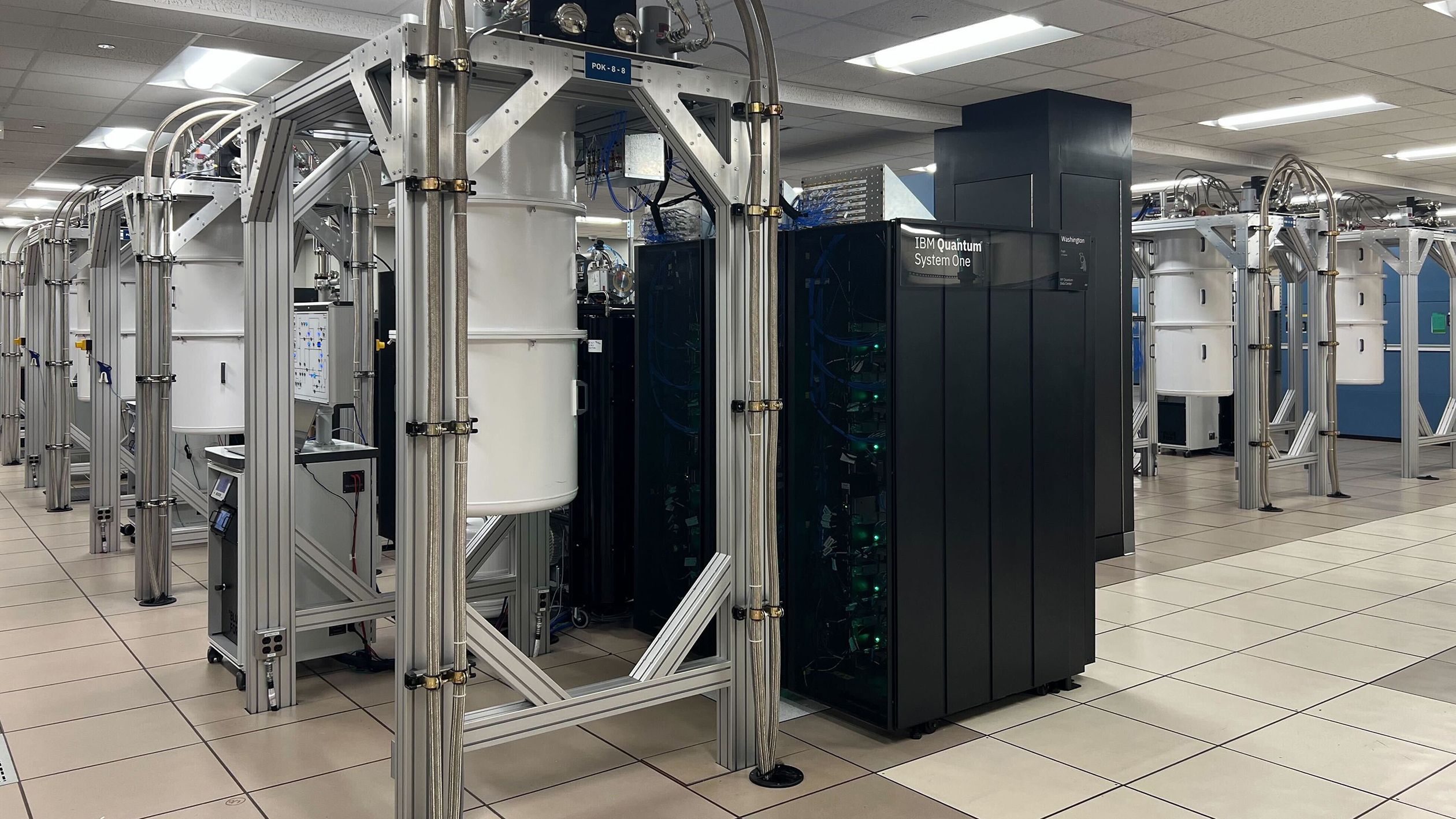
The comparison spans neutral atoms, trapped ions and superconducting systems, covering both gate-model machines and annealers. Room-temperature platforms avoid the cryogenic plant required by superconducting processors, while annealers address different workloads from general-purpose gate-model systems. The article assesses facility demands, current HPC deployments and published milestones toward logical qubits; it excludes software, control-electronics and cloud-aggregation companies.
Centres can own a processor, host one operated by a vendor, or provide remote access to a vendor-hosted machine. The best fit depends on the intended users, available facilities, staffing, access terms and integration with workload managers and GPU systems—not just a vendor’s specification sheet.
QuEra’s neutral-atom Gemini, a 260-qubit gate-model system, is installed at Japan’s AIST beside the ABCI-Q GPU supercomputer. It operates at room temperature and has published fidelities of 99.9 percent for single-qubit gates and 99.2 percent for two-qubit gates. QuEra’s Libra system, targeting 256 logical qubits and about a million reliable operations, is planned for Amazon Braket in 2028. The company has also announced an on-premises integration path through HPE Cray environments.
IQM has systems operating at the Leibniz Supercomputing Centre and Oak Ridge National Laboratory. Its superconducting machines require dilution refrigerators; its LUMI-IQ agreement with Finland’s CSC sets out a staged route from a 150-qubit system in 2027 to an upgrade capable of logical-qubit operations in 2029, with up to nine logical qubits. Fujitsu’s 256-qubit superconducting system is part of AIST’s ABCI-Q hybrid facility, and the company targets a 1,000-qubit machine for fiscal 2026. Its access is primarily through collaborative research.
At Germany’s Jülich Supercomputing Centre, D-Wave’s JUPSI-1 and JUPSI-2 Advantage2 annealers provide production access through JUNIQ. Each system has more than 4,400 qubits, but annealing is aimed at optimisation and sampling rather than gate-model algorithms. IonQ’s 100-qubit Tempo system is being installed at Korea’s KISTI for planned service in the first half of 2027; its Forte Enterprise system has operated at EPB’s Chattanooga quantum centre since September 2026.
AQT’s trapped-ion computers run at room temperature in two 19-inch racks and use under 2 kW. Its 20-qubit systems operate at the Leibniz Supercomputing Centre and Poznan Supercomputing and Networking Centre, making them compact options for integration and algorithm development. Rigetti’s plans include a 9-qubit Novera system for the Pittsburgh Supercomputing Centre’s TangleLab testbed and a 108-qubit system ordered by India’s C-DAC. Its target of 1,000 qubits at 99.9 percent two-qubit fidelity is three years out.
The deployments are not all at the same stage: some are operating, while others remain contracted or in installation. Centres comparing bids should check delivery status and dated roadmap milestones, alongside power, cooling, footprint, environmental limits, service arrangements and the work required to connect a processor to existing HPC systems.
Comments (0)
No comments yet. Be the first!